
Global Pharmacovigilance Future Overview (Segment Forecasts, 2021 – 2028)
The global pharmacovigilance market size was valued at USD 6.33 billion in 2020 and is expected to expand at a compound annual growth rate (CAGR) of 11.5% from 2021 to 2028. An increase in the prevalence of chronic diseases, such as oncological diseases, diabetes, and cardiovascular and respiratory disorders, has led to an increase in drug consumption worldwide. Therefore, the demand for new drug development via extensive clinical trials has increased. Pharmacovigilance (PV) is the inevitable part of drug discovery and development procedures. The increasing incidence of Adverse Drug Reactions (ADRs) is expected to accelerate the demand for PV services. The market is hammered by the appearance of the COVD-19 (coronavirus) pandemic. The evolving threat of COVID-19 infection is affecting businesses, communities, industries, and lives around the world. Safety reporting and medical monitoring are necessary as several potential therapies are being used to treat coronavirus induced infection. The medications like Remdesivir and other old drugs, such as Lopinavir/Ritonavir and hydroxychloroquine (HCQ), are being used/repurposed to treat coronavirus infection. The chances of suspected ADRs for some of these medicines have already been submitted to the individual case safety reports database named VigiBase managed by UMC.
The presence of a competitive environment for introducing new molecules in the market has led to high demand for improved manufacturing operations, pharmacovigilance, clinical data management, streamlined R&D, and medical writing. Manufacturers are rapidly considering outsourcing as a viable cost curbing tool. Outsourcing helps increase internal resource flexibility, improve timelines, and gain better outcomes in the short- and long-term. It also helps achieve better pharmacovigilance through regulatory compliance, higher quality, better productivity, and improved strategic decisions.
There is an increase in the government’s effort to improve management in pharmacovigilance practices. For instance, in 2018, DIA conducted a conference addressing the risk strategies and drug safety involved in pharmacovigilance. Moreover, the European Medicines Agency (EMA) took the Patient Registries Initiative to facilitate the establishment of new registries and to make better use of the existing ones. The initiatives like these are anticipated to propel the market growth in the forthcoming years. The presence of non-profit organizations for spreading awareness related to PV is expected to drive the market in the coming years. For instance, the International Society of Pharmacovigilance (ISoP) is expected to facilitate the adoption as it is focusing on enhancing the proper and safe usage of drugs at the global level.
Moreover, regulatory mandates on clinical trial conduct and post-marketing vigilance are expected to spur the demand for PV services in the coming years. For instance, the European Medicines Agency (EMA) and the U.S. Food and Drug Administration (FDA) formulate regulatory guidelines for all phases of clinical trials. The advancements in the development of ADR databases and information systems enabled reporting accurate information, which can be further utilized by research professionals for prospective studies, thereby fueling the overall demand.
Service Provider Insights
Contract outsourcing held the dominant share of 59.24% in 2020 and is expected to witness the fastest growth in the forthcoming years. This is due to the benefits associated with outsourcing such as risk mitigation, resource flexibility, reduction of upfront investments, and lower fixed cost. Contract outsourcing organizations provide solutions, such as process design Standard Operating Procedure (SOP), PV audits, and other customized services.
The dynamic growth of the contract outsourcing segment can also be attributed to the rapidly emerging CROs providing end-to-end clinical trial solutions, especially in the emerging economies of Asia Pacific, such as India, China, and Japan, enabling resources sharing, cost efficiency, resource flexibility, and expansion of operative capabilities. Outsourcing PV services are accompanied by benefits such as delivering services pertinent to highly complex regulatory requirements, helping to add scalability to accommodate growing product portfolios, and achieving aggressive cost targets. Contract outsourcing also helps reduce the complexity of clinical trials, allows faster approval of trials, and helps effective utilization of internal resources.
The in-house segment is anticipated to witness moderate growth over the forecast period as a consequence of extensive R&D by major pharmaceutical and biotechnological companies for the development of new drugs. This is expected to serve this industry with growth potential in the forthcoming years.
Report Coverage & Deliverables
- Competitive benchmarking
- Historical data & forecasts
- Company revenue shares
- Regional opportunities
- Latest trends & dynamics
Product Life Cycle Insights
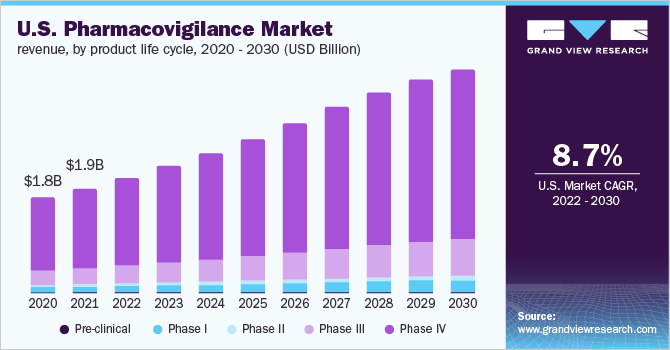
The phase IV or the post-marketing clinical trial segment led the market with a 75.61% share in 2020. These solutions act as an additional safety measure for the drugs undergoing clinical trials. Phase IV is an imperative stage of clinical trials as unsuspected adverse drug reactions can be detected in this stage. Therefore, the data collected and assessed during this stage is expected to be of the highest relevance owing to intensive drug testing on large patient demographics of the highest relevance after commercialization of the drug.
The phase III segment is expected to witness lucrative growth over the forecast period. Phase III trials are done to determine and establish the efficacy of drugs. These trials also provide additional information regarding possible drug interactions, drug safety, and effectiveness before the commercialization of the drug. The aforementioned factors are expected to drive revenue generation in the segment over the forecast period.
Type Insights
Spontaneous reporting held the largest share of 30.34% in 2020 owing to its wide usage in the detection of new, serious, and rare ADRs and its popularity as an efficient and inexpensive method. Wide usage of surveillance reports generated through this method by pharmaceutical industries and regulatory authorities is also responsible for the significant share of spontaneous reporting.
Cohort Event Monitoring (CEM) is projected to witness significant growth over the forecast period owing to increasing application in the detection of a wide range of adverse clinical events. Conjugation of CEM with statistical tools and data mining systems, such as longitudinal health records, is responsible for the growing popularity of this type. It serves as an active form of surveillance method, which can also be used for new as well as older medicines, thus driving the segment.
Targeted spontaneous reporting is anticipated to witness the fastest growth in the near future owing to rising government initiatives to incorporate reporting methodologies other than spontaneous reporting by the European Network of Centers for Pharmacoepidemiology and Pharmacovigilance (ENCePP). Moreover, the benefits associated with targeted spontaneous reporting such as lower labor costs, greater affordability, feasibility in poor resource settings, and usage in routine monitoring are expected to fuel the segment growth.
Electronic Health Record (EHR) mining is increasingly used to identify risk factors for patients after discharge from hospitals. Electronic health records are imperative sources of medical information about clinical events in hospitals and research organizations. The benefits associated with EHR such as improved quality of care, clinical decision-making, automated access, and improvement of clinical workflow and patient management are anticipated to fuel the segment growth over the forecast period.
Process Flow Insights
Signal detection dominated the market with a revenue share of 39.24% in 2020. Spontaneous Reporting Systems (SRSs) use the dominant source of signals through which the suspected cases get voluntarily reported by the healthcare professionals to the other regulatory bodies. Accurate signal detection depends on various factors such as knowledge of the database, quality data, and tools designed to summarize, visualize, and evaluate the data. Nowadays, Artificial Intelligence(AI) and big data are being used by companies for better assessment of signals.
The case data management segment is expected to witness the fastest growth over the forecast period. The adverse event information can be generated from various modes, such as post-marketing programs, clinical trials, spontaneous reports, and literature.
Therapeutic Area Insights
The oncology segment held the largest share of 26.54% as of 2020. Monitoring the safety of cancer drugs is very important due to the associated side effects, which is propelling the demand for pharmacovigilance services. The drugs mostly have intrinsic biological toxicity and narrow therapeutic window, which can lead to serious adverse reactions in the body. The increasing incidence of cancer resulted in accelerated R&D and clinical research.
Pharmacovigilance helps in the early detection and spontaneous reporting of adverse drug reactions. Moreover, recent advancements in cancer treatments, such as targeted therapy, have some serious adverse effects and can compromise a patient’s quality of life. For instance, monoclonal antibodies were listed among the top 10 entries for spontaneous ADR reports with around 406,352 records from 2014 till 2018. Constantly changing reporting systems and emerging technology in pharmacovigilance are driving the segment.
End-use Insights
In 2020, pharmaceuticals held the largest share of 42.63% in terms of revenue. Outsourcing the pharmacovigilance process is practiced by pharma companies to avoid high upfront investments and fixed overhead costs, increase resource flexibility, and secure additional capacity. Outsourcing pharmacovigilance proves to be a cost-effective endeavor for small and medium-sized companies.
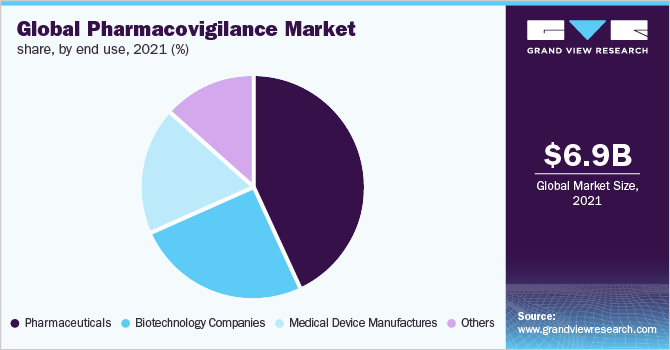
The biotechnology companies segment is anticipated to witness lucrative growth in the forthcoming years owing to increasing new product development activities in this sector. In recent years, drugs are being developed and consumed at increasingly high rates. The use of drugs over longer periods by a large population can lead to adverse effects not seen in the clinical trials. For instance, Vioxx (an osteoarthritic/ acute pain medication) and Avandia (an anti-diabetic) were marketed for some time before a pattern of safety problems were detected with their use. The growing need for medical information by the regulatory authorities is also anticipated to fuel the growth of this segment.
Regional Insights
North America held the largest revenue share of 33.97% in 2020 owing to the presence of key pharmaceutical and medical device players, contributing to the overall revenue in this region. The rising level of drug abuse and associated adverse drug reactions is a leading cause of morbidity and death. This acts as a high-growth rendering factor for the market growth in North America. Rising investment in novel drug development by major players is also anticipated to propel the regional market growth. Consequentially, as a result of the large production of drugs, the number of clinical trials and the need for post-marketing surveillance have increased, thereby contributing to the overall growth of the regional market.
Asia Pacific is expected to register a lucrative CAGR of 13.2% during the forecast period owing to the availability of various outsourcing organizations. Consequentially, there is improved productivity, cost efficiency, and resource sharing that is anticipated to propel the regional demand for pharmacovigilance in the forthcoming years. Furthermore, increasing awareness among patients, rising investments, and supportive government initiatives for meeting the requirements of the population are the factors driving the regional market.
Key Companies & Market Share Insights
The market is experiencing a significant boost owing to the patent expiration of branded drugs and the increasing number of new drug developments. This has attracted several local and international pharmacovigilance service providers. The presence of a competitive milieu has led to improved clinical data management and has streamlined the R&D process.
The market is competitive in nature with key participants involved in continuous product development, collaborations, partnerships, and alliances to augment market penetration. For instance, in December 2019, Accenture and UCB announced the collaboration to accelerate data processing and help in improving patient safety, thereby widening their businesses in their respective markets. The rising number of Contract Research Organizations (CROs) and increased demand for outsourcing services are expected to further fuel the competition in the near future. Some prominent players in the global pharmacovigilance market include:
- Accenture
- Linical Accelovance
- Cognizant
- Gratisol Labs
- Laboratory Corporation of America Holdings
- IBM Corporation
- ArisGlobal
- ICON plc.
- Capgemini
- ITClinical
- FMD K&L
- IQVIA
- TAKE Solutions Ltd.
- PAREXEL International Corporation
- BioClinica Inc.
- Wipro Ltd.
- United BioSource Corporation
Pharmacovigilance Market Report Scope
| Report Attribute | Details |
| Market size value in 2021 | USD 6.97 billion |
| Revenue forecast in 2028 | USD 14.95 billion |
| Growth Rate | CAGR of 11.5% from 2021 to 2028 |
| Base year for estimation | 2020 |
| Actual estimates/Historical data | 2016 – 2019 |
| Forecast period | 2021 – 2028 |
| Quantitative units | Revenue in USD million/billion & CAGR from 2021 to 2028 |
| Report coverage | Revenue forecast, company share, competitive landscape, growth factors, and trends |
| Segments covered | Service provider, product life cycle, type, process flow, therapeutic area, end-use, region |
| Regional Scope | North America; Europe; Asia Pacific; Latin America; MEA |
| Country Scope | U.S.; Canada; U.K.; Germany; France; Italy; Spain; Russia; Japan; China; India; Brazil; Mexico; South Africa; Kingdom of Saudi Arabia |
| Key companies profiled | Accenture; Linical Accelovance; Gratisol Labs; Cognizant; Laboratory Corporation of America Holdings; IBM Corporation; ArisGlobal; ICON plc.; Capgemini; ITClinical; FMD K&L; IQVIA; TAKE Solutions Ltd.; PAREXEL International Corporation; BioClinica Inc.; Wipro Ltd.; United BioSource Corporation |
| Customization scope | Free report customization (equivalent up to 8 analysts’ working days) with purchase. Addition or alteration to country, regional & segment scope. |
| Pricing and purchase options | Avail customized purchase options to meet your exact research needs. Explore purchase options |
Segments Covered
This report forecasts revenue growth at the global, regional, and country levels and provides an analysis of the latest industry trends and opportunities in each of the sub-segments from 2016 to 2028. For the purpose of this study, Grand View Research has segmented the global pharmacovigilance market report on the basis of service provider, product life cycle, type, process flow, therapeutic area, end-use, and region:
- Service Provider Outlook (Revenue, USD Million, 2016 – 2028)
- In-house
- Contract Outsourcing
- Product Life Cycle Outlook (Revenue, USD Million, 2016 – 2028)
- Pre-clinical
- Phase I
- Phase II
- Phase III
- Phase IV
- Type Outlook (Revenue, USD Million, 2016 – 2028)
- Spontaneous Reporting
- Intensified ADR Reporting
- Targeted Spontaneous Reporting
- Cohort Event Monitoring
- EHR Mining
- Process Flow Outlook (Revenue, USD Million, 2016 – 2028)
- Case Data Management
- Case Logging
- Case Data Analysis
- Medical Reviewing & Reporting
- Signal Detection
- Adverse Event Logging
- Adverse Event Analysis
- Adverse Event Review & Reporting
- Risk Management System
- Risk Evaluation System
- Risk Mitigation System
- Case Data Management
- Therapeutic Area Outlook (Revenue, USD Million, 2016 – 2028)
- Oncology
- Neurology
- Cardiology
- Respiratory Systems
- Others
- End-use Outlook (Revenue, USD Million, 2016 – 2028)
- Pharmaceuticals
- Biotechnology Companies
- Medical Device Manufacturers
- Others
- Regional Outlook (Revenue, USD Million, 2016 – 2028)
- North America
- U.S.
- Canada
- Europe
- U.K.
- Germany
- France
- Italy
- Spain
- Russia
- Asia Pacific
- Japan
- China
- India
- Latin America
- Brazil
- Mexico
- Middle East and Africa
- South Africa
- Kingdom of Saudi Arabia
- North America
JOB PROSPECTS
The Drug safety specialist draws an average salary of $90,000 USD per year in USA, Europe & India depending on the knowledge and hands-on experience in Oracle Argus Safety Database. The Drug Safety specialist job roles are in high demand and make a rewarding career.
Frequently Asked Questions by Pharmacovigilance Resources
- How big is the pharmacovigilance market?
The global pharmacovigilance market size was estimated at USD 6.33 billion in 2020 and is expected to reach USD 6.97 billion in 2021.
- What is pharmacovigilance market growth?
The global pharmacovigilance market is expected to grow at a compound annual growth rate of 11.5% from 2021 to 2028 to reach USD 14.95 billion by 2028.
- Which segment accounted for the largest pharmacovigilance market share?
North America dominated the pharmacovigilance market with a share of 34.3% in 2019. This is attributable to the presence of key pharmaceutical & medical device players and investment in novel drug development by them in this region.
- Who are the key players in the pharmacovigilance market?
Some key players operating in the pharmacovigilance market include Accenture; Gratisol Labs; Linical Accelovance; Cognizant; Laboratory Corporation of America Holdings; IBM Corporation; ArisGlobal; ICON plc.; Capgemini; ITClinical; FMD K&L; IQVIA; TAKE Solutions Ltd.; PAREXEL International Corporation; BioClinica Inc.; Wipro Ltd.; and United BioSource Corporation.
- What are the factors driving the pharmacovigilance market?
Key factors that are driving the market growth include an increase in drug consumption rate around the world and thereby the prevalence of ADRs. The rising level of drug abuse and associated adverse drug reactions is a leading cause of morbidity and death. This acts as a high growth rendering factor for the pharmacovigilance market.
- Which is the major service provider segment in the pharmacovigilance market?
The contract outsourcing segment led the pharmacovigilance market with a market share of 59.24% in 2020.
- Which are the major end-use segments in the pharmacovigilance industry?
The pharmaceutical segment led the pharmacovigilance market with a revenue share of 42.63% in 2020, while the biotechnology companies segment is projected to see substantial growth through 2028.
- Which region is expected to show notable growth in the pharmacovigilance market in the coming years?
The Asia Pacific region is expected to register a lucrative CAGR of 13.2% through 2028, owing to the availability of various outsourcing organizations.
- What is the impact of the COVID-19 pandemic on the pharmacovigilance industry?
The Coronavirus pandemic has led to a significant number of deaths around the world, which has made safety reporting and medical monitoring highly necessary in the context of potential treatment therapies.
- Which was the leading therapeutic segment in the pharmacovigilance market in 2020?
The oncology segment led the pharmacovigilance market in 2020, with the increasing incidence of cancer leading to accelerated R&D and clinical research.




Recent Comments